
Introduction
In 1993, a room full of the most skilled craftspeople in Hollywood watched a four-minute demo reel and went quiet. What they saw on screen wasn’t just a better dinosaur. It was the end of everything they knew how to do, and the beginning of something none of them could yet imagine. It’s a story with direct implications for the future of the marketing agency.
Every major technology shift in the entertainment industry over the last 50 years followed the same arc: fear, disruption, adoption, and then an explosion of work that dwarfed everything that came before.
Every major technology shift in the entertainment industry over the last 50 years followed the same arc: fear, disruption, adoption, and then an explosion of work that dwarfed everything that came before. It has happened three distinct times with another just beginning.
The data from five decades of disruption makes a case that’s hard to ignore. And it has a direct bearing on the future of the marketing agency business, specifically, on why the agencies paying attention right now are about to inherit a much larger market than the one they’re currently serving.
The Pattern
When you plot U.S. entertainment industry employment from 1977 to the present, a shape emerges that repeats itself across five decades. It is not a line of steady growth. It is a series of waves, each one triggered by a technology that the industry initially feared, each one followed by a period of expansion that dwarfed what came before.
The pattern, stated plainly: Fear. Disruption. Adoption. Explosion.
It happens everywhere, and there are three distinct times in entertainment.
Chart showing U.S. entertainment industry employment from 1977 to 2026
Employment chart with annotated technology disruption cycles showing the pattern: fear and dip, then explosion of output and jobs, repeating from digital VFX in 1993 through to AI beginning in 2023.
1993: The Creature Shop Gives Way to the Render Farm
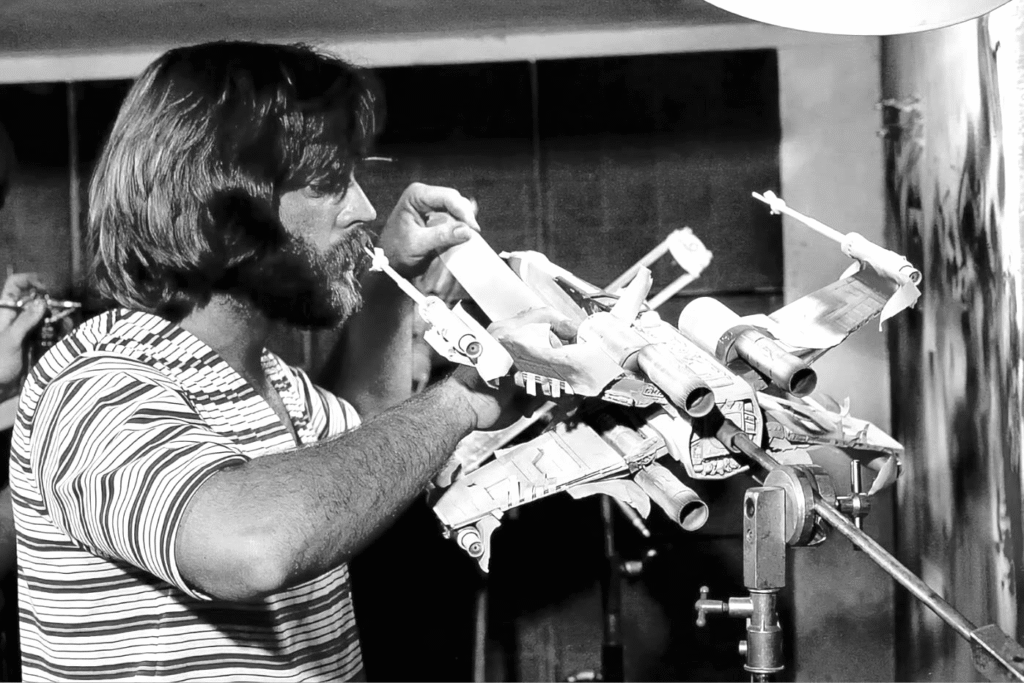
Before Jurassic Park, visual effects in Hollywood meant practical effects: puppets, animatronics, stop-motion models photographed frame by frame done by places like the Creature Shopt. The craftspeople, who built these things, were extraordinarily skilled, and the films they contributed to — The Empire Strikes Back, E.T., Aliens — remain technical achievements by any standard.
…the broader industry did something more dramatic than survive: it exploded.
ILM had been pushing into computer graphics since the early 1980s, producing the Genesis Effect sequence in Star Trek II and the stained-glass knight in Young Sherlock Holmes. But these were isolated experiments. The dominant mode of effects filmmaking remained physical until Spielberg made a decision that changed everything.
The T-rex in Jurassic Park was supposed to be a puppet. Phil Tippett, one of the great stop-motion animators in Hollywood history, was hired to create it. Then the CGI (computer generated imagery) tests came back, and everyone in the room, including Tippett, understood that something had fundamentally shifted. Tippett reportedly said that he was “extinct.”
He wasn’t extinct. He adapted, moved into supervising digital animation and rendering, and continued working for decades. And the broader industry did something more dramatic than survive: it exploded. The visual effects industry that Jurassic Park helped inaugurate grew from a handful of specialized studios to more than 300 firms within a decade. Total entertainment employment, when you account for the full ecosystem, climbed sharply through the 1990s. The work didn’t disappear. It multiplied.
The creature shop craftspeople, who learned to work alongside digital tools, became the senior talent at the new studios. Those who didn’t were, in some cases, left behind. But the industry as a whole — the number of people employed, the number of productions made, the range of stories that could be told — grew in ways that the practical effects era never could have sustained.
2002: Film Labs, Digital Cameras, and the Democratization of Cinema
The second wave arrived nearly a decade later, when George Lucas shot Star Wars: Episode II — Attack of the Clones entirely on digital cameras. It was the first major studio film to be shot, edited, and distributed in a fully digital ecosystem. The 35mm film labs, the camera rental houses built around film magazines, the technicians, who had spent careers mastering the physical properties of celluloid, all of them felt the ground shift.
The fear was familiar in shape: new technology, old skills suddenly less central, and an established craft under pressure from something cheaper, faster, and controlled by fewer people.
What followed was familiar in shape, too. Digital cameras didn’t shrink the market for cinematography. They expanded it. Suddenly, a filmmaker without a studio budget could shoot something that looked genuinely professional. The barrier to entry for independent production collapsed. Sundance swelled. Festivals multiplied. The number of films being made in the United States climbed steadily through the 2000s, reaching levels that the film lab era could never have supported economically.
Digital filmmaking didn’t just change how movies got made. It changed who could afford to make them.
Digital filmmaking didn’t just change how movies got made. It changed who could afford to make them.
The Digital Imaging Technician — the DIT, a role that didn’t exist in the 35mm era — became one of the most in-demand positions on a film set. Skills shifted. Some workers left. New workers entered. The industry grew.
2013: Streaming and the Impossible Number
The third wave is the one that’s easiest to measure, because FX Networks Research has been tracking it in detail since 2009. In that year, there were 210 original scripted series available to American audiences across all platforms. By 2022, that number had reached 599, a number that had nearly tripled in 13 years.
That growth didn’t happen despite the disruption of traditional broadcast television. It happened because of it. Netflix, Amazon, Apple, Disney+, HBO Max, Peacock — each new streaming entrant needed original content to justify its existence. The demand for writers, directors, actors, crew, and post-production talent surged to levels that the three-network broadcast era could never have generated.
Broadcast veterans were right to be concerned about their specific corner of the industry. Cable ratings declined. Some network shows were cancelled. Jobs at specific studios were lost. But the total number of people employed in entertainment, and the total volume of content being made, grew to historic highs. The Motion Picture Association tracked total supported employment — every job that exists because of the film and television industry, from production assistants to equipment rental staff to caterers on location — at 2.32 million at its pre-pandemic peak.
In 1977, the year Star Wars was released and ILM was founded, that number was roughly 1.1 million.
U.S. movies and scripted TV shows produced per year from 1977 to 2026.
The Future of the Marketing Agency Looks Familiar
Here is where the entertainment industry story stops being history and starts being a map.
Most branding and marketing agencies serve a narrow band of the market, companies large enough to absorb the cost of real strategic and creative work. A full brand strategy engagement, done properly, requires real research, real strategic thinking, real creative development. That takes time. Time costs money. And for a lot of companies in the $5M–$50M range, the math hasn’t always worked in their favor.
AI changes that math. Not because it replaces the thinking (it doesn’t), but because it can compress the time required to do certain types of work that used to require more hours than a smaller client could afford. Research synthesis that took three days takes three hours. First drafts that required a full week of iteration can be pressure-tested in a fraction of that time. Visual concepts that once required a full design sprint can be explored, discarded, and refined before a client ever sees them.
The market for great creative work just got a lot bigger.
The result isn’t that we do less work. It’s that we can do the same caliber of work for a wider range of clients.
The result isn’t that we do less work. It’s that we can do the same caliber of work for a wider range of clients. The bar for what “affording a real agency” means gets lower. The market for what we offer gets larger.
This is exactly what digital filmmaking did for independent cinema. The tools didn’t make the stories less valuable. They made the stories more accessible. More directors could tell them. More audiences could find them. The craft still mattered, maybe more than ever, because suddenly everyone had access to the same camera, and the only differentiator was what you knew how to do with it.
The Fear Is Legitimate. So Is the Opportunity.
I want to be careful not to make this sound easier than it is. The transitions in the entertainment industry were real disruptions, not gentle evolutions. Phil Tippett’s fear was legitimate. The film lab technicians, who lost their jobs to digital cameras, were not wrong to grieve what was lost. The broadcast veterans, who watched cable ratings crater, were not being dramatic.
The disruption that AI is creating in creative work — in agencies, in studios, in newsrooms, in design firms — is real. Some work will be lost. Some roles will change in ways that feel like loss even when they’re also gains. The speed of this particular transition is faster than any of the previous ones, which means the window for adaptation is compressed in ways that are genuinely difficult.
But the pattern holds. It has held across five decades and three major technology shifts in a single industry. In each case, the tool that seemed to be eliminating work ended up creating more of it. In each case, the expansion of access — to production, to storytelling, to distribution — grew the total market rather than dividing a fixed one.
The WGA and SAG-AFTRA strikes of 2023 mark, on the employment chart, the clearest evidence of where we are in the arc. It is the fear-and-disruption phase. It is the moment when the old tools and the new ones are in open conflict, before the industry has found a way to absorb and integrate what’s coming.
The fear is valid. The transition is real. But if the future of the marketing agency follows the same pattern that reshaped Hollywood three times over, the aggregate outcome is a larger and more creative industry on the other side.
— Isham Colosetti is the founder and CEO of Creative Mischief, a B2B branding and marketing agency in Atlanta. Creative Mischief works with founders, CMOs, and PE operating partners at mid-sized companies navigating inflection points.
creativemischief.com